Thursday, May 20, 2010

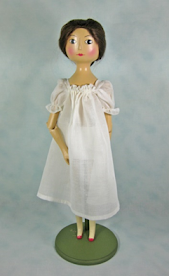
Nell, a China Head Doll from the 1850's


This is a photo of a reproduction china head doll that I purchased recently.  She will be the final doll in my collection that will be representing the historical period between 1776 and 1860.  She stands about 11.5 inches tall.  Her entire wardrobe at the moment consists of the batiste petticoat she is seen wearing, with a coordinating pair of pantaloons underneath.  She actually is next in line to receive a new wardrobe.  It will take me a little time to get to that, as I have a few non-doll-related tasks to get accomplished before then.


Saturday, May 15, 2010

Abigail, a Grödnertal Doll of 1830


Grödnertal dolls are carved wood dolls originated from the Gardena Val, a valley in the Dolomites of South Tyrol, now located in northern Italy.  The area historical was claimed by several countries, including Italy, Austria, and Germany.  The area is known for its skilling, rock climbing, and wood carving.  It is the wood carving that is of interest here.  The valley has a 400-year history of making peg wooden dolls, which were turned on a lathe and also finished with hand carving. 

The doll below is is a Grödnertal doll from Jonathan Green & Company online.  It isn’t the exact doll that I bought from them, but is very close.  (I didn’t have the heart or energy to strip my doll naked to take a picture of her).

From the Jonathan Green website:  “These replicas of the early 1900s “Penny Wooden” dolls are made in the Grödner Tal region where the original dolls are made.  Each doll is turned and hand painted by the artist Judith Sotriffer who carries on this 400 year old tradition.  Each doll is different.  Variations in the wood and in the painting . . . are part of the doll’s handmade charm. The 29cm/11.41 inch size is perfect for sewing.  In fact, she has her own set of patterns available from Wish Booklets.” Judith Sotriffer’s website [https://shop.groednerpuppe.com] indicates that the dolls are carved from cembra pine, which is native to the Gardena Val.

In 2020, the French Fashion Doll Sewing Club online group had a challenge to make an outfit for their doll representing an outfit from a movie or novel set in from 1755 to 1920.  The instructions were simply to “select a favorite movie, TV program, or novel for your inspiration” in dressing your doll.  When I saw the notice for the Cinema/Novel Event, I thought that the dresses that I was making for Abigail were very much like the costumes worn by the lovely ladies, young and old, in the mini-series, Cranford, set in rural England in the early 1840’s.  So I created photos of the dresses I had made as my entry in the challenge. 

To begin, I took a screenshot of the opening credits to the first season of Cranford, pausing the video at a point in between the written opening credits.  Then, using Photoshop,  I superimposed a photo of my doll wearing one of several costumes that I had made.  In each photo, Abigail is posed as one of the female characters, dressed as that character would have been in the mini-series, Cranford. 

The first photo below shows Abigail dressed as Miss Mattie in her younger days.  The dress is adapted from the morning dress pattern in Susan Sirkis’ Wardrobe for a Wooden Doll.  The bodice has a natural neckline, with long full sleeves that are gathered with shirring at the upper arm and into cuffs at the wrist.  The long full skirt is attached to a high waistline.  Abigail wears a separate white collar which has pointed Val lace around its outer edge.


The next photo is Abigail as Mary Smith, who is visiting Miss Mattie.  The dress is made from striped cotton that I bought from Gail Wilson’s website back when she had a ton of fabric for sale.  I cut the fabric for the bodice on the bias, so that the stripes form a V pattern.  The full skirt is attached to a bodice high waistline.  The long full sleeves are gathered at the upper arm by shirring and end at narrow cuffs.  Abigail wears a brown straw bonnet with a white ribbon hat band decorated by brown and white pheasant feathers.


Abigail is shown here wearing the same dress as above, but this time without the bonnet but with a white batiste apron.  It is gathered to a band at the top, to which are attached two white satin ribbon apron strings.  The two sides and bottom of the apron are embellished with ½” Val lace.


Here below Abigail represents Larentia Galindo, the milliner.  This outfit was adapted from the cover outfit on the Wishbooklet 1820-1825, by Susan Sirkis.  The white cotton batiste blouse has a high band collar and vertical tucks on the bodice front.  The long full sleeves end in simple cuffs.  There is a narrow black silk ribbon bow at the center front neckline.  The skirt is made of tan, gray and black plaid fabric with a double ruffle around the bottom.  The top of the upper ruffle is bordered with a narrow black silk ribbon band.  The hat is a cream colored straw embellish with a black ribbon hat band and black trim border around the outer edge.  White feathers completed the embellishment.


In this shot Abigail is playing Sophie Hutton wearing “the dress for a vicarage bride.”  This dress is adapted from pattern 21 of Susan Sirkis’ Wishbooklet 1831-1835.  The lined bodice and sleeves are made from white voile.  The bodice has a low scooped neckline, with several horizontal pleats across the upper bodice.  The sleeves are short and very puffed.  The skirt is made from a length of Swiss embroidery, with an overall pattern of lilies of the valley and a lower edge of scalloped embroidery.


And finally, here Abigail plays Jessie Brown wearing mourning clothes after the death of her sister.  This dress is made of black batiste.  There are vertical tucks on the bodice.  The plain neckline is embellished with gathers of white Val lace.  The full gathered sleeves are also embellished with the same lace at the cuffs.    Abigail wears a black straw bonnet decorated with a plain dove gray silk satin ribbon hat band, and with ties of the same ribbon.

The following dresses are ones that I made for Abigail but that were not part of my Cranford challenge entry. This first one is a simple dress based on the morning dress in Wardrobe for a Wood Doll.  The bodice has been modified to have a natural neckline.  The sleeves are leg of muttons, with upper arm fullness and lower arm narrower.  There is no cuff.  The full skirt is gather to a high waistline.  The dress is tan colored cotton printed with widely scattered sprigs. Abigail wears the brown straw hat that is decorated with a white ribbon hat band and pheasant feathers.   


This red cotton dress is modeled on an 1830’s dress found on the Internet.  It is adapted from the morning dress pattern of Susan Sirkis’ Wardrobe for a Wood Doll.  Gold soutache forms a scroll pattern around the upper bodice and around the lower sleeves.  The same gold soutache forms a double zig zag pattern around the lower skirt.  There is a red fabric belt with an antique gold colored buckle at the waist.  Abigail is wearing a natural straw hat with a red hatband.  It is decorated by gold roses and red petal flowers.  She wears the red decorated hat with this red and yellow dress, as well as with the two red and yellow dresses that follow.


The dress below begins with the morning dress from Susan Sirkis’ Wardrobe for a Wood Doll.  The dress is made from what would be called a sprigged cotton calico, with little red three-leaved sprigs scattered across a yellow background.  The sleeves are gathered by shirring at the upper arm, and then the fullness of the sleeve is released at the elbow and then gathered again at the cuff.  This pattern is used in the AnneLise Wilhelmsen article, “Isn’t It Romantic?” in Doll News, Spring 2014.  The scooped neckline is edged with a very narrow Val lace.  The full skirt is gathered to the high-waisted bodice and has a large ruffle at the bottom.  The waist has a red band around it.


The next dress began with the pattern for the morning dress in Susan Sirkis’ Wardrobe for a Wood Doll.  It is made from red calico with greenery and yellow flowers.  The dress has leg of mutton sleeves, in which the upper arm is covered by a large puffed sleeve, while the sleeve narrows considerably over the lower arm.  I added cuffs contoured to fit the lower sleeve, with an edging of Val lace that has a pointed outer edge, rather than scallops.  I made the waistline of the bodice fit at the natural waist, and added a pelerine of white batiste, with the same lace used on the cuffs used around the edge of the pelerine.  The pelerine closes at the neck with a single white button and a thread loop on the other side.  The full skirt is gathered at the high waist, and has a 2½” ruffle at the lower edge.  The dress has a waistband of golden yellow silk ribbon.


This dress is made from pink-on-pink sprigged cotton.  The pink is a shade of dusty old rose. The bodice is made from the day dress pattern in Susan Sirkis’ Wardrobe for a Wood Doll.  It has a narrow self binding around the scooped neckline.  The sleeves are short puffed sleeves.  To gather the fullness of the sleeves, cartridge gathers are used at the cuffs.  The full gathered skirt is attached to the high waistline of the bodice and the skirt has a full gathered ruffle at the lower edge. There is a dyed-to-match pink silk satin sash around the waistline that ties in a bow at the back.

This is the pièce de resistance of Abigail’s wardrobe.  It is a pink silk taffeta ball gown  The bodice has very full puffed sleeves with narrow cuffs of the pink silk.  There is a broad V collar with 1¼” val lace attached at the lower edge.  The lace was cut so that the full 1¼” width is attached at the top of each shoulder, and then the lace tapers down to nothing at the center front and center back. There is a gathered ruffle of the same lace at the lower edge of the dress.  The skirt is gathered with cartridge pleats attached to the high bodice waistline.


I wanted to make just a simple nightgown, so I started with pattern 8 from Susan Sirkis’ Wishbooklet 1853-1858.  I made the center placket considerably longer, to make it easier to get on and off the doll.  The nightgown has a high yoke, to which the slightly gathered skirt is attached.  The center placket is edged with ¼” Val lace. I eliminated the little collar used in the pattern and just used the same Val lace gathered around the neckline.  The sleeves are long and full, ending in cuffs to which there is also Val lace gathered.  The center placket closes with eight ⅛” white buttons and tiny handmade buttonholes.  I agonized in making those buttonholes!

Abigail is wearing a wrapper here for which pattern 12 from Susan Sirkis’ Wishbooklet 1931-1935 was used. It is made of white cotton batiste.  It has a fitted bodice with a V-shaped yoke delineated by a ruffle of ¾” Val lace.  There is a small white collar edged with ¼” Val lace.  The skirt is gathered.  The sleeves are long and fully gathered, ending in cuffs edged with ¼” lace.  There is a small white silk bow at the neckline and a larger one with streamers at the waist.  The wrapper closes with hooks and eyes down the front.

The final photo shows Abigail in her pantaloons and petticoat.  Both pieces are made of white cotton batiste.  There are three tucks around the bottom of the petticoat, with a ⅝” band of Swiss embroidery.  The bottom of each leg of the pantaloons also has three tucks and a band of the same Swiss embroidery.


Monday, May 10, 2010

Marguerite, a Tuck-Comb doll of 1810


Tuck comb dolls are a special style of peg wooden dolls, which are a type of wooden doll that originated in Germany and the Netherlands.  Peg wooden dolls began as simple lathe-turned dolls from the Val Gardena in the Alps.  These dolls were sold undressed.  Young girls would then make clothes for them.  In the United States, a simple version of peg wooden doll sold for one cent, and thus they were called penny dolls.  Peg wooden dolls are so called because wooden pegs are used to connect the arms and legs to the body.  Sometimes a single peg was used to connect both arms or both legs, the peg running through the torso.  In this case, the arms (or legs) moved in tandem, rather than separately.

Tuck comb dolls are peg wooden dolls that have carved hair combs.  Generally, the head and body are turned as one piece, with separately attached arms and legs.  The hair is generally painted with sometimes elaborate curly bangs and with a painted comb.  Tuck comb dolls appeared in the early part of the 19th century.  They usually had elongated, graceful proportions, nicely carved details, painted slippers, and sometimes accessories such as wooden pendant earrings.  My tuck comb doll below is named Marguerite, after one of my French Andriot ancestors.  

Below is the tuck comb doll that I made from a kit by Gail Wilson.  She is not a wood doll, but rather has paper maché head, arms and legs on a cloth body.  She does have the style and proportions typical of a tuck comb doll.  She is wearing a slip typical of the 1810’s. 

Below are two close-ups of her face.  Before painting, I added paper clay to her bald head and put in striations, copying the style from an historic example that I found.  I also made the earrings from paper clay.  I painted the hair and facial features with acrylic paints, but cheated on the curlicue bangs and used a fine nib marking pen.


Here is Marguerite in her satin batiste gown.  It is my simplified version of a gown worn by Elizabeth Bennet in the 1995 version of Pride and Prejudice.  This style of gown was worn circa 1810.  The gown has a very high waist, as was the style in that historic era.  There are tucks set in the middle of the high bodice, directly under a squared neckline.  The straight sleeves are elbow length.  There is a white silk satin sash around the high waistline, which ties in a bow with long streamers in back.  The side view shows that the skirt is fuller in the back than in the front.  That also was very characteristic of the style then.

Below is a close-up of the embroidery on the skirt, the design for which came from a Susan Sirkis Wish Booklet.  Trying to get a clear photograph of white embroidery on white fabric is a bit difficult.  


Wednesday, May 5, 2010

Charity, a Queen Anne doll from 1776

2010 will focus on the earliest historic period represented by my dolls.  This period runs from the time of the American Revolutionary War (1776) up until the era immediately preceding the American Civil War (1860).  In this time period, the dolls were carved from wood or molded from paper maché.  At the very end of this period, dolls with china heads began to appear.  The bisque-headed dolls that dominated the next fifty years would not appear for a few years more.  The earliest doll from this historic period in my collection is Charity,  a doll carved from wood, described below.  


Queen Anne dolls were used as a marketing tool in the century before the American Revolution.  Merchants would dress the dolls in miniature versions of clothing by design and made in European fashion centers and then ship the thus-dressed dolls through their country and abroad to show potential buyers what the current styles were.  In England, the dolls used in these marketing ploys were called Queen Anne dolls.  In France, they were known as Pandoras.  And in colonial America, they were called French babies.  It should be noted that the dress worn by Charity, my Queen Anne doll, probably does not represent the height of couture in England, France, or colonial America.  

The photo below shows is the way that Charity came to me.  She was designed by Fred Laughon, who was well-known for his Queen Anne dolls and doll furniture.  She was produced for the 46th annual convention of the United Federation of Doll Clubs, which was held in Philadelphia in 1995.  Charity is a 14 inch tall peg wooden “Queen Anne” style doll.  Her features are painted and she has a mohair wig that is styled into a bun at the nape of her neck.  My Charity is number 1095 of 1510. It should be noted that the dress worn by Charity, my Queen Anne doll, probably does not represent the height of couture in England, France, or colonial America.  

I have several other peg wooden dolls representative of this historic period.  I think that this UFDC doll is very similar in construction to those other peg woodens and is pretty typical of the period.  The clothes in which she came, however, bear very little resemblance to the gowns that colonial women actually wore.

This close-up of Charity’s face shows some of the characteristics typical of Queen Anne dolls.  The features are stylized, with pale skin and eyes without pupils.  Other features not seen in Charity include dotted eyebrows and “fake” beauty marks. 

Here is Charity undressed.  She is made of wood.  Her arms are jointed at the shoulder and elbows with pegs.  Her legs are pegged to her torso at the hips, and her knees are pegged as well.  These pegs allows the movement of all these joints.  The feet are very small compared to the rest of her body.  She has painted white stockings and red slippers on her feet.  

I realize that this is not a very good photograph.  It was taken years ago with a very old camera.  I would take another now, but for the fact that I only made one outfit for Charity and she is sewn into it.  It would be a major project to get her out of it now and then back into it later. 

One of my goals in dressing Charity was to make as authentic as possible 18th century clothing for her.  The first undergarment that a colonial woman would put on is a chemise.  At left Charity is wearing a typical chemise of that era.  Unfortunately, the full sleeves did not fit under the dress that I eventually made for her, so I made another chemise with straight sleeves for her.

The next undergarment to be put on is the under-petticoat.  Ladies often wore multiple petticoats, in part for warmth and also to support their very full skirts.  Underclothing was usually made of linen and was white, for the ease of washing the garments.  

Women of the colonial era usually wore a set of stays under the bodice of their dresses.  Stays serve a function on human women, but have no effect on dolls except to add bulk.  To avoid that outcome, I didn’t put stays on Charity.

The next undergarment is the outer petticoat.  I made this for Charity out of quilted fabric.  The petticoats of colonial women were often quilted for cold weather wear.  

Here is the dress that I made for Charity.  Colonial women often used striped fabric for their clothing.  Today, we would have stripes running vertically down sleeves, but in colonial clothing, the stripes were set to run horizontally around the sleeve.  The stripes were also often set to run diagonally on the bodice front, which had the effect of making the waist look as small as possible.

The back view of Charity’s dress shows the cartridge pleating that was used to gather 40 inches of fabric into a 4 inch waist.  Cartridge pleats are gathered rather like old-fashioned ribbon candy.  The bottom edge of the bodice is completely finished, and then one edge of each cartridge pleat is catch-stitched to the bodice.  

Finally, here is a picture of Charity’s hat.  This style was very common in colonial days, usually made of straw.  The photograph changed the color of the ribbon somewhat.  In actuality, it is a close match to the color of the dress.  


Sunday, May 30, 2004

Hitty's Dresses, By the Book

2004 is all about Hitty and her friends.  First, going in reverse chronological order, there are six postings in May about the original Hitty doll and her comrades.  Then, there are two posts about the Hittys' two-room mansion, consisting of a bedroom and a sitting room.  This first posting below is about the original Hitty.  

In Hitty: Her First Hundred Years, Dorothy Lathrop drew the delightful illustrations. Many of the illustrations depict Hitty in dresses that are described in the story written by Rachel Field. I have been reproducing those dresses as closely as I'm able. When I first wrote this posting, I was about half way through. I just finished the last of the dresses, and have added photos of them further down.

In the story, Hitty's first dress is sewn by Phoebe Preble. Phoebe's mother would not let poor Phoebe play with the doll until she was decently clothed:
Phoebe's mother had decided that I was not to be played with until properly clothed. Phoebe was not a child who took readily to sewing, but her mother was firm, so presently out came needles and thread, thimbles and piece-bag, and I was being measured for my first outfit. It was to be of buff calico strewn with small red flowers, and I thought it was very fine indeed.
The cover of the 1998 paperback edition of Hitty shows Dorothy Lathrop's illustration of the dress that Phoebe Preble made. I made an exact copy of the dress by first scanning in the cover illustration. I then cropped one of the little flower clusters, straightened the image, and then duplicated it in a diagonal pattern. The background color of the fabric was also taken from the cover illustration. I then printed the image on a fine batiste ironed onto freezer paper.

The Hitty in the photographs is Hitty Faith, who is a DRC Hittykin resin doll, made by DeAnn Cote. Hitty Faith was my first Hitty, and I think she comes closest to looking like the first Hitty of all I've seen. Hitty's necklace is real coral beads, strung on elastic, so that it can be removed. The dress closes in back with loops and three 1/8" buttons.

In Hitty, Phoebe Preble also made her doll a pair of pantaloons and a chemise, with her name embroidered on it. Hitty describes how she came by her name:
At first, I was christened Mehitabel, but Phoebe was far too impatient to use so many syllables, and presently I had become Hitty to the whole household. Indeed, it was Mrs. Preble's suggestion that these five letters were worked carefully in little red cross-stitch characters upon my chemise.
 "There, said Phoebe's mother when the last one was done, "now whatever happens to her she can always be sure of her name."
Hitty's chemise is shown in several illustrations, including one in which she is burrowing in her trunk. In trying to reproduce the chemise and pantaloons, I quickly noticed that there were no closures on the chemise, either in front or in back. There is a button at the waist, so presumably the petticoat was separate. I assume that the chemise depicted was pulled on over the head. That might have worked for an illustration doll, but it didn't work for a real doll. I found that a neckline big enough to go over Hitty's head also tended to slip off her shoulders. So my Hitty's chemise is buttoned up the back, and the petticoat is attached to the chemise. The fabric is cotton voile, and the lace is French cotton val.
After having been lost by Phoebe Preble on a sea voyage, Hitty was purchased as a birthday gift for 4-year-old Little Thankful. The dress that Phoebe had made was long gone, but Hitty still had her chemise, and Little Thankful's mother made Hitty a new dress:
Little Thankful's mother was better at hymns and Bible lessons than dressing dolls. However, I was so glad to feel decent cloth upon my back again that I was in no mood to insist upon the latest fashions. She made me a rather voluminous dress of cotton print, in a far from gaudy pattern. It nearly covered my painted feet, and the ruffle about my neck practically hid my coral beads. But these were small matters. I was clean and comfortable and I belonged to a little girl again.
There is no mention in the book of the colors in the print fabric that Little Thankful's mother used, so I made the solid stripes brown and the little flowers in shades of peach. This is another print that I generated using Adobe Photo Elements, and then printed on batiste. The brown color actually is quite a bit darker than it appears in the photos below.

I made the collar of cotton voile, with tiny loops of tatting for the edging. As there was no illustration of the dress front to limit me, I put the stripes on the bodice front on the diagonal.


Little Thankful was not very thankful to have Hitty when she saw the elegant china dolls that other girls had at a party. Thankful stuffed Hitty down behind the cushions of the horsehair sofa, where Hitty remained for several years. After being discovered, Hitty soon became the doll of Clarissa Pryce, a little Quaker girl. Clarissa herself made Hitty two dresses. Hitty's everyday dress was made of brown sprigs on buff calico. There is no illustration of this dress, so I did some research on the clothing that Quaker girls might have worn in the mid-1800's. I designed the print with brown sprigs on a buff background, and printed the design onto batiste. The dress is plain, with no embellishment, as befitting a Quaker girl. I made a Quaker pinafore to go with the dress, as well as a plain white cap.
The second dress that Clarissa made for Hitty was for Sunday best. It was "a pearl-gray silk, made in true Quaker fashion, with a fine white fichu crossed in front, lawn cap, and all, for First Day, as the Pryces called Sunday."

To make the dress, I dyed a piece of silk broadcloth with Pearl Gray Rit dye. Like the everyday dress, the gray silk dress was plain, with long straight sleeves and no embellishments. The white fichu is made of cotton voile, with a tiny ruffle as depicted in the illustration. In addition to a white cap made of voile, I constructed a straw bonnet for Hitty, made in the Quaker style.


Here's one more photograph of Hitty in her Quaker dress. She is wearing her white cap, the ruffle of which is peaking out from under her straw Quaker bonnet, which itself is tied with a large silk bow. At least, the bow is large on Hitty!


Hitty stayed with Clarissa until after the Civil War. When Clarissa went away to boarding school, Hitty 'went into camphor,' stored away in the attic with moth balls. The box in which Hitty was stored was sent to some New York cousins, where after a length of two years, Hitty was found by Miss Milly Pinch, the household seamstress. To prove her ability to sew fancy clothes, Miss Pinch made a wonderous wardrobe for Hitty. One of the dresses was a dancing dress made of silk. Hitty was soon appropriated by Isabella, an 8-year-old, who took Hitty with her to dance classes. Hitty tried to join in, but as her legs were pegged, they couldn't move independent of each other. As Hitty said "My spirit was willing, but my pegs were not."

I found that making the dancing dress from silk fabric was formidable. Silk drapes wonderfully, but when gathered, it doesn't fall into graceful Hitty-size folds. Instead, it tends to stand out like an umbrella. So I opted to make the dancing dress from sheer cotton voile. However, the ruching at the neckline and hemline is made from silk ribbon, as is the pink sash around her waist.


Another ensemble made by Miss Pinch is described in detail in the book:

How is it possible for my poor pen to do justice to my new attire--to the watered-silk dress with draped skirt, fitted waist, and innumerable bows? How can I describe the blue velvet pelisse embroidered with garlands no bigger than pinheads? How tell of the little feathered hat and the muff of white eiderdown?

Hitty is wearing this ensemble when she falls from Isabella's grasp and tumbles to the ground at the feet of Charles Dickens. Mr. Dickens rescues Hitty, a memorable event for Isabella.

This outfit was the most challenging of all to try to construct. Elsewhere in the book the dress is described as made of blue silk, so I dyed a piece of lightweight taffeta a very light shade of evening blue. The skirt is slightly fuller in the back than the front and has two rows of ecru braid at the hem. Above those are multitudes of ecru silk bows. Only the lower portion of the skirt is shown in the book's illustration, so I designed the bodice myself. It does have a fitted waist, as well as a square neckline and short sleeves. I did not embellish the bodice, as I didn't want extra bulk under the pelisse.

The pelisse is made of cotton velveteen, dyed a darker shade of evening blue. The sleeves and hem are edged with black cotton val lace, and all the edges of the pelisse are bordered with a loopy rayon braid. The garlands are composed of bullion-stitch pink roses and lazy-daisy green leaves. I had to make a few modifications to the sleeve and pocket, because of the nature of the materials I was working with. The little hat is made from the same silk as the dress and does indeed have a blue feather. The muff, rather than made of eiderdown, is made of a piece of faux fur. I had to shave the pile down considerably to make it Hitty scale.


The last dress that is illustrated in the book was made by Miss Pamela Worthington, who rescued Hitty from life as a pincushion doll and made her a dress of sprigged challis, such as Miss Pamela herself had worn as a child. Eventually, still wearing this dress, Hitty is bought at auction by the old gentleman, and goes to live in Miss Hunter's antique shop, where she writes her memoirs.

My 1930's hardcover edition of Hitty has a color illustration of this dress. I used the illustration to reconstruct the fabric in Photoshop, and then printed the fabric image onto cotton batiste. In addition to the color illustration, the book has two other illustrations showing this dress, and in each, the dress is drawn slightly differently. My version is an adaptation of all three.

These are all of the dresses in the illustrations of Hitty: Her First Hundred Years, except for one, which is the glorious bride's dress that Hitty wears at the Cotton Exposition. I know that once I make that dress, I will never want to take it off of my little Hitty. So rather than make the bride's dress for Hitty Faith, who has a plentitude of dresses already, I bought a Hitty made by Susan Sirkis to dress especially as the bride. That dress still needs much planning and thought, but for now, the dresses for Hitty Faith, reconstructing the illustrations in the original version of Hitty, are done.

Tuesday, May 25, 2004

Hitty According to Gail Wilson

Soon after I bought my first Hitty, I discovered the Hitty-size furniture on Gail Wilson's website (www.gailwilsondesigns.com). Many of the pieces of furniture and accessories in my Hitty's bedroom and sitting room are made from GW kits. Gail also sells her version of Hitty, ready-made and in kit form. The original Hitty was carved of wood, while the GW Hitty has molded paper mache head, arms and legs with a cloth body. At first, I wasn't sure that a non-wood doll could truly be a Hitty. But then I realized that my other Hittys were all made of resin, which makes them non-wood dolls. So, I bought a GW Hitty kit and gathered together my courage to make a 6-1/2" doll.
This is the GW Hitty that I made. She is a pudgy little thing, more childlike that the original Hitty. She is named Hitty Charity. (There is also a Hitty Hope, as yet unclothed).

Her petticoat and pantaloons are made of cotton voile, trimmed with cotton val lace. I used simple drawstring closures for both the undergarments, so that I could loosen the strings and let them ride a little below her waist if need be.

Also in this picture are the cotton batiste nightgown and nightcap, both made from a GW pattern.

Here is Hitty Charity in the dress made from the fabric included in the Hitty doll kit. She also has a pinafore, both garments being edged with a crochet-type lace. The instructions had the option of embroidering "Hitty" on the bib of the pinafore, but obviously I chose to keep the bib plain.

Also in the picture is Hitty Charity's cape, made of thin cotton flannel. I wanted a forest green flannel, but couldn't find any in the fabric stores, so I dyed it. While I was at it, I also dye a piece of cotton batiste with which to line the hood and collar. I had a piece of narrow jacquard ribbon with a touch of green in the design. I thought it made a good trim for the cape, giving it a Tyrolean flavor.

Hitty Charity is wearing what I think of as a pioneer girl's outfit in this picture. It doesn't show up well in the photo, but the dress fabric is a little cream-on-tan print. Hitty Charity has a pioneer bonnet made of the same fabric. To go over her dress there is a navy-and-tan checked apron, which buttons in the back.

On the dress form is a blue-on-white print dress, which the pattern identifies as one of Hitty's 'best dresses.' This is the style of dress worn by Miss Columbia, a late 1800's cloth doll.

In the GW pattern, this dress was described as a Quaker outfit, designed to be made in gray fabric. I made it decidedly non-Quakerish by using dark red fabric. In the pattern, the dress was two pieces, a blouse and skirt, with the white fichu tucked into the waistband of the skirt. I made the dress all one piece, and modified the fichu so that it tied around in the back. Both are ways that women in the early 1800's wore fichus. Hitty Charity is wearing a Quaker cap, which basically is like the caps worn by women of that time period. At her feet is a Quaker bonnet, with silk ribbon ties and a ruffle to protect her neck.

In this photo, Hitty Charity is wearing a very simple dress, made of a brown-on-tan cotton print. The dress has a hand-dyed brown silk sash as an accent.


In this picture, Hitty Charity is wearing a dusty pink print dress. I dyed the sash to match the darker shade of pink in the print. It took several tries to get the right color! Also, Hitty has a pink bonnet that she can wear with her dress, which has its own hat box. When I made the hat box, I got the lid a little tight. It comes off, but it takes a lot of doing.

Here Hitty Charity is wearing a brown cardigan sweater that goes so nicely with her brown-on-tan print dress. The sweater was knit by my friend Edna. It has real buttons and buttonholes, as well as the tiniest of ribbings. It certainly will keep Hitty Charity warm in the winter.


And finally, here is Hitty Charity wearing her blue shawl with a matching cap, also knit by Edna. The cap has a tiny eyelet pattern worked around the edge.

I had finished all these dresses and finally declared Hitty Charity's wardrobe complete. Then I learned that Gail Wilson had published two new patterns for Hitty. One is an early 1800's dress, in the style of Jane Austen. The other is a style often worn by dolls in the mid-1800's, such as the Izannah Walker dolls. I can hear Hitty Charity saying that she has absolutely nothing to wear and needs some new dresses!

A Few Weeks Later  . . .

Here is Hitty Charity in her new Jane Austen style dress and bonnet.  The dress is made from white batiste, with a tuck and lace at the wrists, tucks near the hem and a ruffle of lace at the neck.  The sash is made of French blue silk satin ribbon, with a large bow in the back.  This style of dress was popular in the early 1800's, the era depicted in the Jane Austen novels.  
The bonnet is also typical of that era, with a large brim and Hitty's curls showing in the back.  The same ribbon in a narrower size trims the bonnet.

And here is Hitty Charity in a dress typical of mid-19th century doll dresses, like that frequently worn by dolls made by Izannah Walker.   It has a round yoke with a bound neckline.  The bell sleeves gather onto the yoke, as does the body of the dress.  The apron has a printed pattern simulating embroidered doll aprons of that same era, which were often seen in brown, such as this one, or red.  Hopefully, Hitty Charity is satisfied with the state of her wardrobe.  Her sister, Hitty Hope, has not a stitch to wear and is beginning to feel slighted.  Sibling rivalry exists even in the doll world.